What is the name for a change in a population that is not due to genetic change?
Most populations have some degree of variation in their cistron pools. Past measuring the amount of genetic variation in a population, scientists can begin to make predictions most how genetic variation changes over time. These predictions can then help them gain of import insights into the processes that allow organisms to adapt to their environment or to develop into new species over generations, also known as the process of development.
Genetic variation is usually expressed equally a relative frequency, which means a proportion of the total population nether study. In other words, a relative frequency value represents the pct of a given phenotype, genotype, or allele within a population.
Relative phenotype frequency is the number of individuals in a population that have a specific observable trait or phenotype. To compare different phenotype frequencies, the relative phenotype frequency for each phenotype can be calculated by counting the number of times a particular phenotype appears in a population and dividing it by the total number of individuals in the population.
Relative genotype frequency and relative allele frequency are the near important measures of genetic variation. Relative genotype frequency is the percentage of individuals in a population that have a specific genotype. The relative genotype frequencies prove the distribution of genetic variation in a population. Relative allele frequency is the percentage of all copies of a certain gene in a population that acquit a specific allele. This is an accurate measurement of the amount of genetic variation in a population.
Examining allele frequencies
A factor that can occur in two forms is said to accept two alleles. Trunk color in fruit flies is an example of a gene with 2 alleles: a dominant allele for brown torso color, and a recessive allele for black trunk color. The brown body color allele can exist represented as "B" and the blackness trunk color allele as "b." The allele frequencies for a gene with 2 alleles are usually represented by the letters p and q, where the relative frequency of the B allele is p and the relative frequency of the b allele is q.
Symbolically, these relative allele frequencies can be represented equally:
relative frequency (B) = p and relative frequency (b) = q
Call up the Punnett foursquare?
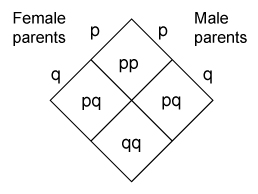
Effigy 1: A Punnett square showing how p and q alleles combine.
If B and b are the simply 2 alleles of a gene, and so possible genotypes tin can exist predicted by arranging the alleles in a Punnett square, in their p and q representation (Effigy 1). This practice tin aid to visualize the computation of relative allele frequencies and their respective relative genotype frequencies in a population.
The possible combinations tin can exist represented mathematically as:
[p × p] + [2 × p × q] + [q × q]
or
pii + 2pq + qtwo
How can relative frequencies be used to study populations?
The mathematical expression p2 + 2pq + q2 can be used equally a platform for agreement both allele frequencies and genotype frequencies in existent populations. For example, if a population does non change over fourth dimension, then scientists tin can make sure predictions virtually its relative allele frequencies, and about its relative genotype frequencies. In other words, if they have data nigh its relative genotype frequencies, they may as well brand predictions about its relative allele frequencies.
When a population is in equilibrium, the BB homozygotes (individuals that carry the same ii dominant B alleles) volition have a relative genotype frequency of p2: freq (BB) = p2. Similarly, bb homozygotes (individuals that carry the same two recessive b alleles) will take a relative genotype frequency of q2: freq (bb) = q2. Finally, the Bb heterozygotes (individuals that behave both the dominant B allele and the recessive b allele) will have a relative genotype frequency of 2pq: freq (Bb) = 2pq.
In a stable population, the sum of all these relative genotype frequencies remains equal to 1 over successive generations. This is a mathematical fashion of expressing that the sum of all relative genotype frequencies always equals i because if one relative genotype frequency increases, another will decrease in tandem, and alleles go redistributed rather than increasing in proportion to the population. Therefore, this relationship tin be expressed mathematically as follows:
This equation is known every bit the Hardy-Weinberg equation, and it defines a population in which relative allele frequencies practise not modify over successive generations. Such a population is said to be in equilibrium. This state of equilibrium represented by the Hardy-Weinberg equation is an ideal model against which to compare observed changes in relative allele and genotype frequencies in natural populations.
How is the Hardy-Weinberg equation used?
The Hardy-Weinberg equation describes a population at equilibrium. This tin can but occur in the absence of disturbing factors and when mating between individuals is completely random. When mating is random in a large population, both the relative genotype and allele frequencies will remain constant.
Hardy-Weinberg equilibrium in a population tin exist disturbed by a number of forces, including mutations, nonrandom mating, migration and genetic drift (random changes in alleles from one generation to the next). These forces drive evolutionary change because they add to or take away from the relative allele frequencies in a population. For example, mutations can disrupt the equilibrium of relative allele frequencies by introducing new alleles into a population. Nonrandom mating can influence relative genotype frequencies within the mating group, because mate selection of the parents tin can crusade a bias toward sure combinations of alleles among their progeny. Migration causes a phenomenon chosen gene menstruation that occurs when breeding betwixt two populations leads to the transfer of alleles into a new population, thereby altering the equilibrium of relative allele frequencies. Genetic drift, which typically occurs at a college rate in small populations, takes place when relative allele frequencies increase or decrease past chance.
Since all of these disruptive forces commonly occur in nature, the Hardy-Weinberg equilibrium rarely stays constant. Typically, populations can exist in equilibrium for brusque periods of time, but rarely stay there in perpetuity. Therefore, Hardy-Weinberg equilibrium describes an arcadian country of a population, and genetic variations in nature tin can be measured as changes from this ideal. The Hardy-Weinberg equation is therefore a tool for measuring real genetic variation in a population over time.
This is only i model
A population at Hardy-Weinberg equilibrium exhibits constant relative allele and genotype frequencies over successive generations. However, the antipodal is not necessarily true: a population that exhibits stable relative allele and genotype frequencies over time may not be in Hardy-Weinberg equilibrium. For instance, if the heterozygous genotype provides an advantage (e.k. allows individuals to mate more successfully or provides resistance to disease), it will remain prevalent in the population, notwithstanding it volition not occur in the proportion predicted by the Hardy-Weinberg equation.
Source: https://www.nature.com/scitable/topicpage/the-variety-of-genes-in-the-gene-6526291/
0 Response to "What is the name for a change in a population that is not due to genetic change?"
Post a Comment